Every day, millions of liters of wastewater flow from our homes, offices, and industries into drainage systems. For decades, the conventional approach was “out of sight, out of mind”—discharge it into rivers or the ocean and forget about it. But in 2025, with water scarcity intensifying and environmental regulations tightening, that approach is no longer viable or acceptable.
Modern sewage treatment plants (STPs) represent a fundamental shift in how we view wastewater: not as waste, but as a resource. At Vaari Nirvana, we install SusBio Ecotreat systems that transform sewage into clean water suitable for reuse—closing the water loop and creating sustainable water management systems.
This blog demystifies sewage treatment technology, explains how modern STPs work, and explores why they’re essential for sustainable development.
The Wastewater Challenge: Understanding the Problem
Before diving into solutions, let’s understand what we’re dealing with. Sewage contains:
- Organic matter (human waste, food particles, soap residues)
- Suspended solids
- Pathogens (bacteria, viruses, parasites)
- Nutrients (nitrogen and phosphorus)
- Various chemicals from household products
Untreated sewage discharged into water bodies causes multiple problems:
- Depletes oxygen levels, killing aquatic life
- Spreads waterborne diseases
- Creates foul odors
- Triggers algal blooms that further degrade water quality
The Yamuna, Ganges, and countless other Indian rivers bear witness to decades of inadequate sewage management.
Centralized municipal sewage systems, where they exist, are often overburdened and outdated. Many cities treat only 30-40% of generated sewage, and treatment quality is inconsistent. This is where decentralized sewage treatment—using on-site STPs at residential complexes, industries, and institutions—becomes crucial.
The SusBio Ecotreat System: Engineering Elegance
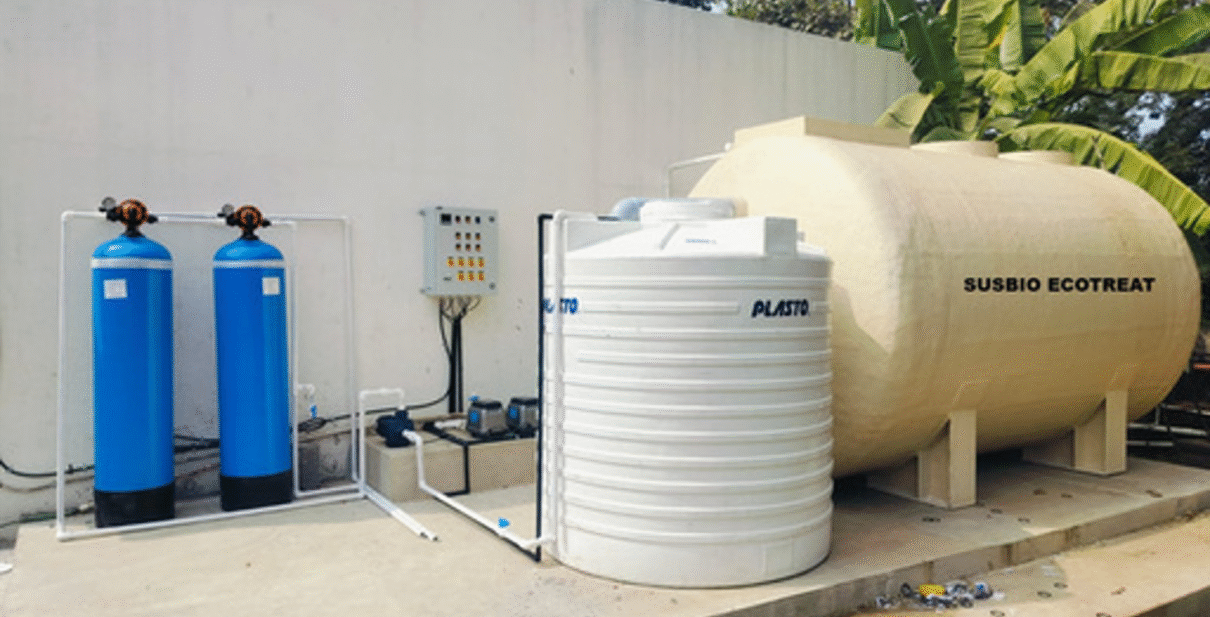
The SusBio Ecotreat system we install represents advanced biological sewage treatment in a compact, efficient package. Unlike traditional STPs that require large land areas and complex infrastructure, Ecotreat is prefabricated, modular, and space-efficient.
Compact Footprint:
A 100 KLD (kiloliters per day) system occupies just:
- Length: 2.7 meters
- Width: 0.4 meters
- Depth: 0.8 meters
This compact design fits in tight urban spaces where conventional STPs would be impossible to install.
The Seven-Stage Treatment Process
The system uses a multi-stage biological treatment process that mimics and accelerates nature’s own water purification methods. Let’s walk through each stage:
STAGE 1: Influent Entry & Screening
Raw sewage enters the system through the inlet chamber. Initial screening removes large debris—plastic, cloth, sticks—that could damage equipment or clog the system. Flow equalization ensures steady treatment load even when discharge patterns vary throughout the day.
STAGE 2: Sedimentation and Separation
Wastewater flows into the first chamber where gravity does the initial work. Heavy solid particles—grit, sand, larger organic matter—settle to the bottom while lighter materials like oils and greases float to the surface. This physical separation removes approximately 50-60% of suspended solids, preparing the wastewater for biological treatment.
The settled solids accumulate as sludge, which is periodically removed and can be composted or further processed. This primary treatment stage protects downstream biological processes from clogging and overloading.
STAGE 3: Anaerobic Treatment
The partially clarified wastewater moves into the anaerobic chamber—an oxygen-free environment where specialized bacteria break down complex organic compounds. These anaerobic microorganisms don’t require oxygen; instead, they use the organic matter itself as their energy source.
During this process:
- Complex proteins, fats, and carbohydrates are converted into simpler compounds
- The organic load (measured as BOD – Biochemical Oxygen Demand) is reduced by 40-50%
- Biogas (methane and carbon dioxide) is produced as a byproduct
Benefits of Anaerobic Treatment:
- Energy-efficient (no aeration required)
- Produces less excess sludge
- Can generate biogas for energy in larger systems
- Handles high organic loads effectively
The bacteria work slowly but steadily, requiring retention times of 12-18 hours for effective treatment. Contact media in the chamber provides surface area for bacterial colonization, enhancing treatment efficiency.
STAGE 4: Aerobic Treatment with MBBR Technology
This is where the magic happens. The water flows into the aerobic chamber equipped with Moving Bed Biofilm Reactor (MBBR) technology. Aeration blowers continuously supply oxygen, creating an environment where aerobic bacteria thrive.
How MBBR Works:
The chamber contains specially designed plastic carrier media—small cylindrical shapes with high surface area. Beneficial bacteria colonize these media surfaces, forming biofilms. As wastewater flows through, the bacteria consume remaining organic matter, converting it into:
- Carbon dioxide (CO₂)
- Water (H₂O)
- Additional bacterial biomass
Advantages of MBBR Technology:
- Maintains high bacterial concentrations in compact space
- Moving media ensures uniform contact between bacteria and wastewater
- Prevents dead zones and ensures thorough treatment
- Highly efficient: reduces BOD by 85-90%
- Handles flow and load variations effectively
The continuous aeration also nitrifies ammonia—converting it to nitrates—which is important for meeting discharge standards and making the water safer for reuse.
STAGE 5: Secondary Sedimentation
After aerobic treatment, water enters a clarifier or secondary sedimentation chamber. Here, bacterial flocs and any remaining suspended particles settle out under gravity. The clear supernatant—now substantially cleaned—flows toward the final treatment stage.
The settled activated sludge serves two purposes:
- Return Activated Sludge (RAS): Partially returned to the aerobic chamber to maintain bacterial populations
- Waste Activated Sludge (WAS): Excess sludge is removed for disposal
This recirculation ensures the system maintains optimal bacterial concentrations for efficient treatment.
STAGE 6: Disinfection (Chlorination)
The final step is disinfection to kill pathogenic bacteria, viruses, and parasites that might have survived biological treatment. Chlorine or chlorine-based compounds are added in a contact chamber where they remain in contact with water for sufficient time (typically 30 minutes) to achieve disinfection.
Chlorination Process:
- Measured dose of sodium hypochlorite or calcium hypochlorite is added
- Contact time ensures complete pathogen destruction
- Residual chlorine is monitored to ensure effectiveness
- Optional de-chlorination removes excess chlorine before discharge
Some advanced systems also offer UV disinfection as an alternative to chlorination, especially when treated water will be used for sensitive applications.
STAGE 7: Effluent Discharge
Finally, the clean and treated effluent exits the system. At this point, the water meets all environmental standards and is suitable for:
- Safe discharge into water bodies
- Irrigation and landscaping
- Toilet flushing
- Cooling tower makeup water
- Industrial processes
- Construction activities
Treated Water Quality: Meeting Standards, Enabling Reuse
The treated water from Ecotreat systems consistently meets Central Pollution Control Board (CPCB) standards:
ParameterStandard ValueWhat It MeansBOD< 10 mg/LVery low organic contaminationCOD< 50 mg/LEffective organic matter removalTSS< 10 mg/LExcellent water claritypH6.5-8.5Neutral, safe for dischargeFecal Coliform< 100 MPN/100mlMicrobiologically safeOil & Grease< 5 mg/LMinimal residual contamination
This quality level makes the water suitable for multiple reuse applications. Many of our clients reuse 60-80% of their treated water, dramatically reducing freshwater consumption.
Example: A residential complex treating 50 KLD might reuse 35-40 KLD for landscaping and toilet flushing, saving substantial water and reducing utility bills by ₹1-2 lakhs annually.
Why Decentralized Treatment Makes Sense
Centralized municipal sewage systems will always play a role, but decentralized treatment at the source offers compelling advantages:
✅ Immediate Implementation
You don’t need to wait for municipal infrastructure. Install an STP and start treating sewage immediately.
✅ Reliability
You control system operation and maintenance, ensuring consistent treatment quality regardless of municipal system performance.
✅ Resource Recovery
On-site treatment enables water reuse where it’s needed, reducing transportation losses and distribution costs.
✅ Regulatory Compliance
Many municipalities now mandate on-site treatment for large water users. An STP ensures you meet environmental regulations and avoid penalties.
✅ Cost Effectiveness
While there’s an upfront capital cost, operational savings from water reuse and reduced sewage charges often recover the investment within 3-5 years.
✅ Environmental Responsibility
Treating sewage on-site prevents pollution, protects local water bodies, and demonstrates environmental stewardship.
Installation and Operation: What to Expect
Installation Timeline:
SusBio Ecotreat systems are prefabricated, meaning most fabrication happens in controlled factory conditions. This ensures quality, reduces on-site construction time, and minimizes disruption.
- Small systems (1-10 KLD): 1-2 weeks
- Medium systems (10-50 KLD): 2-3 weeks
- Large systems (50+ KLD): 3-4 weeks
Power Requirements:
The system requires electrical power for aeration blowers:
- Small systems: 0.5-1 kW
- Medium systems: 2-3 kW
- Large systems: 3-5 kW
Daily Operations:
- Visual inspection (5-10 minutes)
- Monitor flow and check aeration
- Record chlorine dosage
Weekly Tasks:
- Clean screens and remove debris
- Check and adjust chlorine levels
- Inspect mechanical equipment
Monthly Maintenance:
- Test treated water quality
- Clean chambers if needed
- Inspect pumps and blowers
- Remove excess sludge
Training & Support:
We provide comprehensive training to your facility management team, covering:
- System operation principles
- Routine maintenance procedures
- Troubleshooting common issues
- Safety protocols
- Record-keeping requirements
Our ongoing support ensures your system operates optimally for years.
Real-World Success Stories
Residential Complex, Hyderabad (25 KLD)
A 150-unit apartment complex installed an Ecotreat STP. Results:
- 70% water reuse for landscaping and toilet flushing
- ₹1.8 lakh annual savings on water bills
- Zero pollution discharge
- Investment recovered in 4 years
Hotel, Bengaluru (50 KLD)
A mid-sized hotel treating all wastewater on-site:
- Meets green building certification requirements
- Reuses water for cooling towers and landscaping
- Enhanced sustainability reputation
- ₹3.5 lakh annual savings
Industrial Unit, Chennai (100 KLD)
A food processing plant required high-quality treatment:
- Consistently meets effluent discharge standards
- Reuses water for cleaning and cooling
- Avoided regulatory penalties
- ₹6 lakh annual savings plus compliance assurance
The Bigger Picture: Circular Water Economy
STPs like Ecotreat are building blocks of a circular water economy—a system where water is used, treated, reused, and returned to nature in clean condition. This approach is essential for sustainable urban development in water-stressed regions.
Vision:
Imagine a residential complex where all wastewater is treated and reused for landscaping, toilet flushing, and water features. Freshwater consumption drops by 40-50%, reducing municipal water demand. Multiply this across thousands of buildings, and the cumulative impact is transformative.
This is the future Vaari Nirvana is working toward—communities that manage water responsibly, treating every drop as precious and ensuring clean water for future generations.
Financing and ROI
Investment Range:
- 5 KLD system: ₹3-5 lakhs
- 10 KLD system: ₹5-8 lakhs
- 25 KLD system: ₹10-15 lakhs
- 50 KLD system: ₹18-25 lakhs
- 100 KLD system: ₹35-50 lakhs
Typical ROI Timeline: 3-5 years through water savings, reduced sewage charges, and avoided penalties
Financing Options:
- Bank loans with green technology benefits
- Government subsidies (where available)
- Corporate sustainability budgets
- Maintenance agreements for predictable costs
Conclusion: Technology Serving Sustainability
Modern sewage treatment isn’t about complex engineering for its own sake—it’s about using proven technology to solve real problems. The SusBio Ecotreat system demonstrates that effective sewage treatment can be compact, affordable, reliable, and produce water quality suitable for reuse.
Whether you’re a residential association, industrial facility, educational institution, or municipality, investing in proper sewage treatment is investing in environmental health, regulatory compliance, and long-term sustainability.
Every liter treated is a liter that doesn’t pollute rivers. Every system installed is a step toward water security. Every community that treats wastewater is building a sustainable future.